01
Neck & back pain
Stiff necks, low-back ache, sciatic pain that travels down the leg. We loosen the tissue and calm the nerve, then look for why it started.
Acupuncture in Wantagh, Long Island
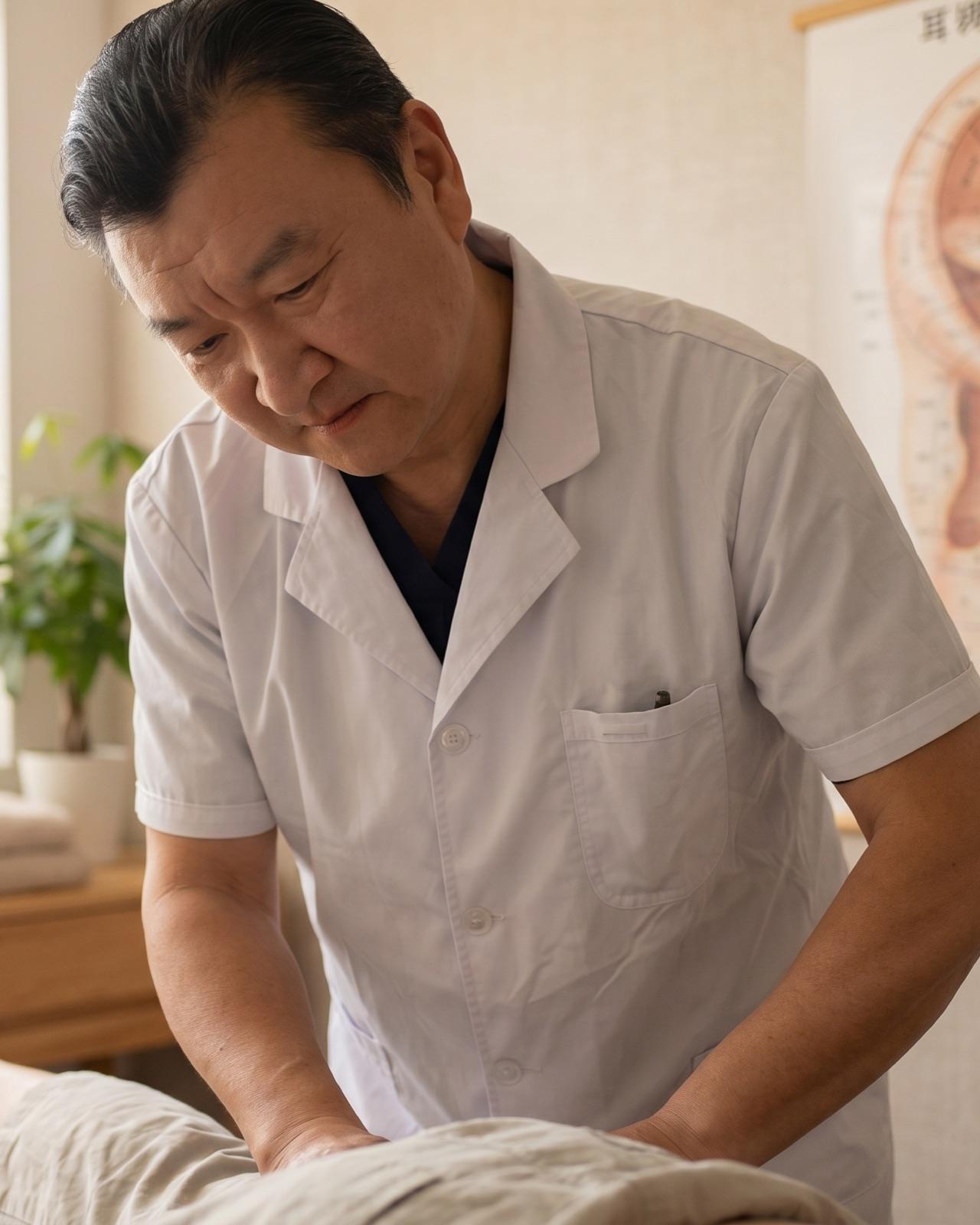
Hair-thin needles, a warm and quiet room, and a clinician who listens, explains, and won't oversell. I help people move from restless nights and everyday pain toward real relief — and I look for the cause, not just the symptom.
治病求本
Treat the root, not just the symptom. The baseline of classical practice.
The gentle method
There's a communication layer right underneath the skin — a loose, responsive layer just below the surface. That's where I work. The needles are hair-thin and shallow, so most patients feel almost nothing going in.
No deep needling, no chasing a strong ache to prove it's working. Gentle is the technique, not a compromise.
The needle reaches only the shallow layer — not deep muscle.
What I treat
Not a cure-all — a focused practice. These are the conditions I see most, and the ones acupuncture is genuinely suited to help with.
Stiff necks, low-back ache, sciatic pain that travels down the leg. We loosen the tissue and calm the nerve, then look for why it started.
Tension headaches and migraines that haven't responded to the usual remedies. Acupuncture may help reduce how often and how intensely they occur.
Frozen shoulder, tennis and golfer's elbow, joint pain that has lingered. Gentle, patient work — session over session.
A quiet room, a heated table, and treatment that settles an overworked nervous system — without sedatives or a hard sell.
Trouble falling asleep, or waking at 3 a.m. and staying up? We treat the pattern underneath, so rest comes more easily on its own.
Acupuncture isn't right for everything, and I won't pretend otherwise. If your situation calls for a different kind of care, I'll say so — and point you toward it.
Three methods
Many acupuncturists work in a single style. I practice three — one traditional system and two modern, muscle- and fascia-focused methods — because different problems respond to different approaches. Part of the first visit is finding the one that fits you.
Restore the flow of Qi and blood.
The oldest of the three. Pain and illness are read as a disruption in the flow of Qi and blood through the body's meridians — fine needles at chosen points redirect and settle it. The focus is the whole person, not just the spot that hurts.
Release the tightened muscle behind the pain.
A modern method that works entirely in the loose layer just under the skin — no deep needling, no meridian points. It finds the tightened muscle (患肌) driving the problem, often somewhere away from where you feel it, and restores normal circulation and movement by releasing it.
Free the fascia while the body moves.
Traditional sinew-channel (经筋) theory meets modern fascia science. You move gently while the needle is placed, so tissue and fascia are worked in action — the emphasis is on precision, movement, and restoring function within the session.

Haidong (Harry) Yu
Licensed Acupuncturist (L.Ac), New York State
About Harry
I grew up in a doctor's house. My father was a surgeon, and he carried the work with a seriousness that shaped all of us. I started down the same road at a Chinese medicine university — and, as a restless young person, I found the old theory dry and walked away from it.
What brought me back was watching my father have a severe stroke. I saw him in pain and had no way to ease it, not even a little. That regret is what made me pick the books up again. The second time, the theory I'd once found tedious read clearly — the way a language does once you've lived enough to need it.
What decided the rest was a patient I watched carried into my teacher's clinic, unable to walk. Twenty minutes of gentle needling and hands-on work later, he stood up and walked out.
That is the medicine I practice now: gentle in the room, careful in the diagnosis, and honest about what it can and can't do.
— Haidong (Harry) Yu, L.AcVerify my license
Your first visit
Plan on about an hour for your first visit.
We start with a real conversation — your pain, your sleep, what you've already tried. No rushing.
Hair-thin needles in the shallow layer just under the skin. Most people feel almost nothing.
You rest in a quiet room while the treatment does its work. Many patients drift off to sleep.
We talk through what to expect and how many visits make sense — or whether acupuncture is the right fit at all.
The honest answers to what first-timers ask most. Still unsure? Call and we'll talk it through — no pressure.
Call (516) 350-8058Free guide
A short, plain-language guide for anyone who's curious but a little nervous. No jargon, no sales pitch.
From patients
No ad campaign writes like a patient does. These are excerpts from public Google reviews — in their words, not ours.
Unedited excerpts from public Google reviews. Every experience is individual — results vary.
Book a visit
Pick a time that works for you, or call and we'll find one together. If you're still deciding, a quick call is the easiest place to start — no pressure, no script.